
Insulation built for Gulf Coast heat and humidity
Spray Foam Insulation in Pensacola, FL
Seal out the muggy air, take the load off your AC and stop the attic from baking the rooms below, with every area priced in writing.
- Free on-site estimates
- Written quote with foam type, thickness and R-value per area
- Moisture, leaks and termite clearances checked before we spray
A Hot, Wet Climate Changes the Job
Spray foam insulation in Pensacola is less about holding heat in and more about keeping heat and moisture out. The 1991-2020 normals for Pensacola International Airport, as listed on Wikipedia, put the average July high at 91.6F and the average July low at 75.3F, with 68.31 inches of rain a year falling on about 115 days. Nights that barely drop below 75 mean the air conditioner hardly rests from May to October, and every gap in the house lets in air loaded with water. We seal those gaps and insulate the spaces that need it, using open-cell or closed-cell foam where it pays and blown-in insulation where it does the job for less.
What the code asks for here
OpenEI's list of IECC climate zones places Escambia County and Santa Rosa County in Climate Zone 2A, the warm-humid zone that covers most of Florida. Under the 2023 Florida Building Code, Energy Conservation (8th edition), as summarized by the Insulation Institute, Zone 2 houses built prescriptively need R-38 in the ceiling and R-13 in wood-frame walls. For existing homes, the Department of Energy's recommendation for Zone 2 is higher: R-49 to R-60 for an attic with no insulation, or R-38 to R-49 added on top of 3 to 4 inches already in place. Many older Pensacola attics hold far less than that, often a thin, matted layer that has been walked on, wet or nested in.
Where Pensacola houses gain heat
The house types around the bay range widely: wood-frame bungalows and two-story houses near downtown, brick ranches on slabs from the post-war decades, newer two-story subdivision homes in Pace and Navarre, and raised beach houses on the islands. Each lets heat and humidity in at different points. Most share one weak spot: ductwork and an air handler sitting in an attic that can run far hotter than the outdoor air. Leaky ducts in that space pull in hot, wet attic air and push conditioned air out. Older raised houses add a second weak spot underneath, where a vented crawl space lets humid air reach the floor framing.
Closed cell vs open cell in a humid climate
Open-cell foam is soft and light and expands a lot. HomeGuide lists it at R-3.5 to R-3.7 per inch. It seals air well, quiets sound and costs less per square foot, which makes it a common choice for rooflines in sealed attics and for interior walls. Closed-cell foam is dense and rigid, at R-5 to R-7 per inch, and it resists water and slows vapor. Around Pensacola that makes closed-cell the usual pick for crawl space walls, floors over damp crawl spaces, metal buildings and anywhere the foam may see moisture. Neither type is right everywhere, and the quote names the foam for each area along with the reason.
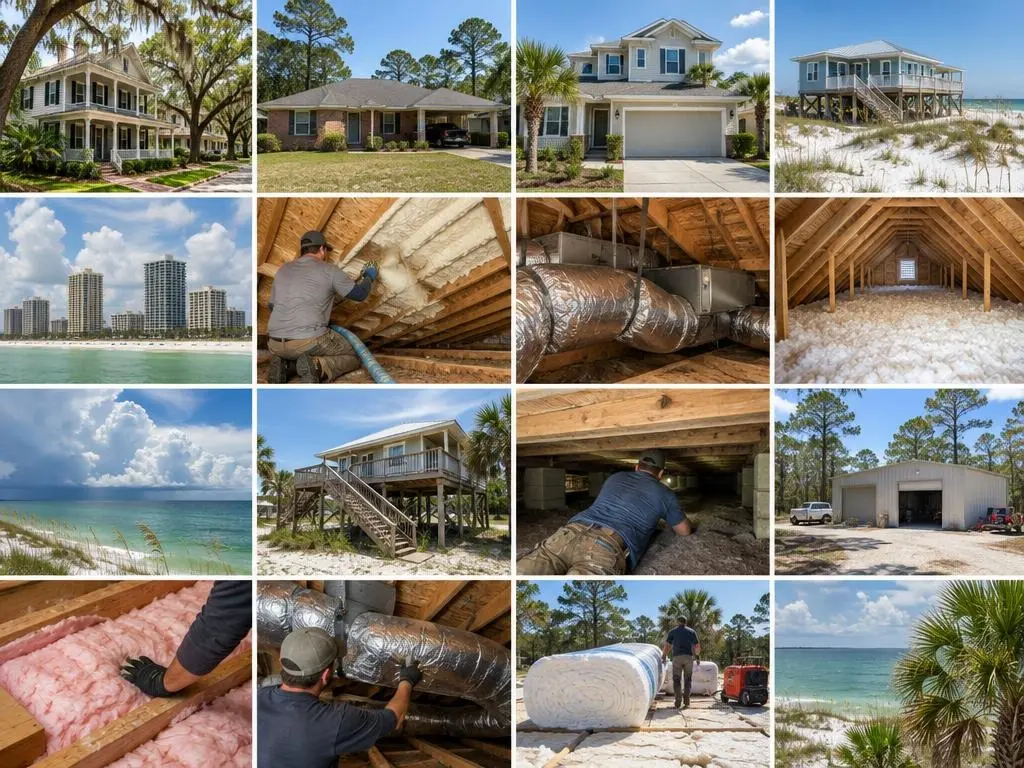
Foam is also not the cheapest way to insulate a wide-open attic floor. On many homes, sealing the leaks at the ceiling and then blowing cellulose or fiberglass to depth gets most of the benefit for less. If both approaches fit your house, you will see them side by side.
Can you spray foam inside existing walls?
It is one of the most common questions we hear. Standard spray foam expands quickly and needs an open cavity, so it is sprayed into walls that are open during a remodel, an addition or storm repairs. For closed walls in an existing house, the usual options are dense-pack blown insulation or special injection foams designed for that purpose, and each comes with limits. Many Pensacola homes rebuilt after Ivan, Dennis or Sally had walls opened down to the studs, and that is the easiest moment to foam them.
What to ask spray foam insulation contractors
A search for spray foam insulation near me in Pensacola turns up plenty of names. Whether you call us or other insulation contractors and spray foam insulation companies around Pensacola, a few questions sort out the careful ones fast. Ask which foam they plan for each area and why. Ask what thickness and R-value the quote lists. Ask how they will handle the ductwork and air handler if the attic is being sealed, and whether the HVAC system should be checked afterward. Ask how long you need to be out of the house (HomeGuide advises at least 24 hours) and how they keep foam clear of the ground and of the areas termite inspectors need to see. If an answer is vague, ask again. We put those details in writing on every job.
Spray foam insulation cost
HomeGuide's 2026 guide puts installed spray foam at $1.50 to $5.00 per square foot. Open-cell runs $1.50 to $3.50 and closed-cell $3.00 to $5.00, which also answers the frequent question about the cost of closed-cell spray foam per square foot. HomeGuide lists an attic at $3,000 to $8,000, a crawl space at $2,000 to $4,000 and a whole house at $8,000 to $20,000, and many installers have a minimum charge of $1,000 to $2,000 or more. Blown-in insulation runs $1.00 to $2.80 per square foot in HomeGuide's blown-in guide. Those are national numbers for planning. Access, foam type, thickness and how much old material comes out decide your real figure, and the written estimate we give you is the price.
Storms, termites and timing
Pensacola has taken direct hits from Ivan in 2004, Dennis in 2005 and Sally in 2020, and storm repairs are often when insulation gets replaced. Wet insulation that was rained on through a damaged roof should come out rather than dry in place. Termites are the other local factor: the Florida Building Commission's termite-protection guidance calls for a 6-inch clearance between exterior foam plastic insulation and the ground, and keeps foam off below-grade foundation walls. We keep foam where it belongs. Unlike colder places, attics here are workable year-round, though midsummer attic work goes on early in the day.
Utility rebates
FPL's Northwest Florida ceiling insulation page lists a $220 instant rebate for homes whose current ceiling insulation is below R-8, installed by an FPL-approved participating contractor after a home energy analysis. The page does not say whether spray foam qualifies, and terms change, so check FPL's page or call them before you plan around it.
Insulation Work We Do
Six kinds of insulation work, matched to each part of your house or building, from closed-cell foam under a raised floor to pulling storm-soaked insulation out of an attic.
Spray Foam Insulation
Open-cell and closed-cell foam that insulates and stops humid air in one layer, for rooflines, walls, floors and metal buildings.
Learn more →Attic Insulation
Seal the ceiling, deal with the ducts and bring the attic up to depth so the rooms below stop baking all summer.
Learn more →Crawl Space Encapsulation & Insulation
Close off humid crawl spaces under raised floors with a sealed liner and closed-cell foam, or insulate the floor above.
Learn more →Blown-In Insulation
Cellulose or fiberglass blown deep across the attic floor, or dense-packed into closed walls, for less than foam on large areas.
Learn more →Metal Building & Shop Insulation
Closed-cell foam on steel walls and roofs so shops, garages and metal buildings stop sweating and stay workable in summer.
Learn more →Insulation Removal & Replacement
Pull out storm-soaked, pest-fouled or crushed insulation, clean up, then insulate again to the right depth.
Learn more →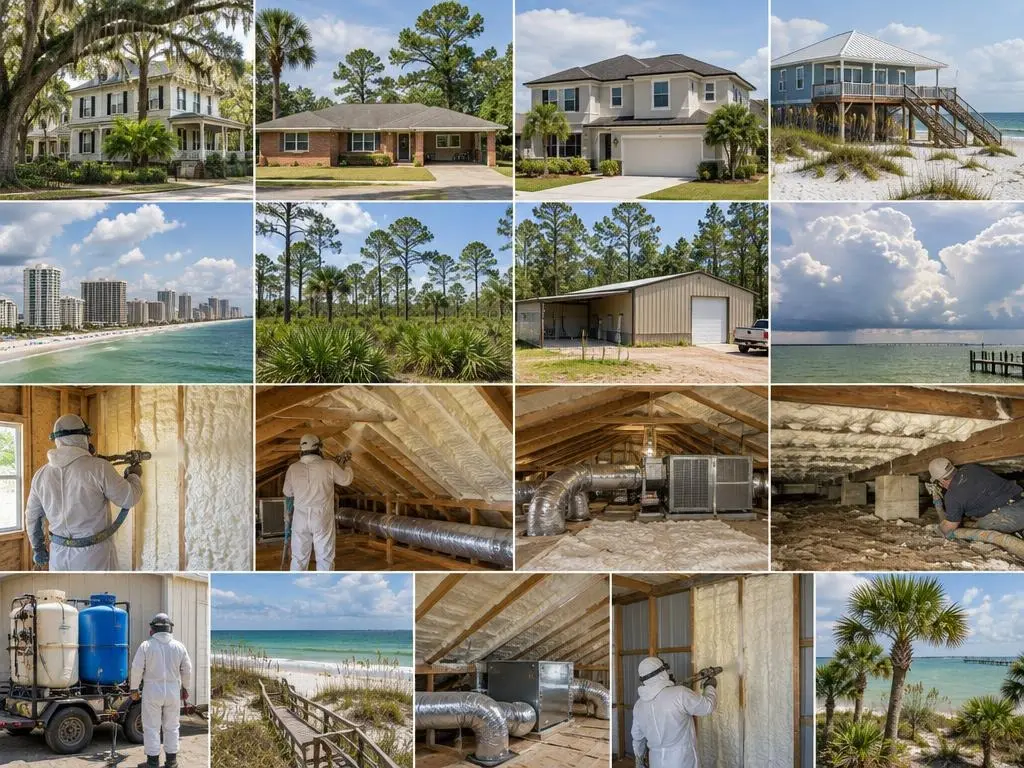
Why Homeowners Call Pensacola Spray Foam Insulation
We look before we price
Every quote comes after an on-site look at the attic, crawl space, walls or building, never a number over the phone.
Humidity is part of the plan
We look at ductwork, the air handler and the crawl space, because in Pensacola moisture is as big a problem as heat.
The right material per area
Open-cell, closed-cell, cellulose or fiberglass, chosen for each surface, with the reason written on the quote.
Numbers you can compare
Each area shows material, thickness or depth, target R-value and price, so bids line up fairly.
Where We Work
We work in Pensacola and the communities around it: Warrington, Myrtle Grove, West Pensacola, Brent, Bellview, Ensley and Ferry Pass on the mainland side; Cantonment, Gonzalez and Molino up the Highway 29 corridor; Gulf Breeze, Pensacola Beach and Perdido Key along the water; Pace, Milton, Midway and Navarre in Santa Rosa County; and Orange Beach just across the Alabama line. Older neighborhoods near downtown have more raised wood floors and thin attic insulation, the suburbs north and west have more post-war ranches with ducts in hot attics, Santa Rosa County has more newer two-story homes, and the islands have beach houses and condos that take the brunt of every storm. Each town page covers what is different there.
- Spray Foam Insulation in Pensacola, FL
- Spray Foam Insulation in Gulf Breeze, FL
- Spray Foam Insulation in Pensacola Beach, FL
- Spray Foam Insulation in Perdido Key, FL
- Spray Foam Insulation in Orange Beach, AL
- Spray Foam Insulation in Warrington, FL
- Spray Foam Insulation in Myrtle Grove, FL
- Spray Foam Insulation in West Pensacola, FL
- Spray Foam Insulation in Brent, FL
- Spray Foam Insulation in Bellview, FL
- Spray Foam Insulation in Ensley, FL
- Spray Foam Insulation in Ferry Pass, FL
- Spray Foam Insulation in Cantonment, FL
- Spray Foam Insulation in Gonzalez, FL
- Spray Foam Insulation in Molino, FL
- Spray Foam Insulation in Pace, FL
- Spray Foam Insulation in Milton, FL
- Spray Foam Insulation in Midway, FL
- Spray Foam Insulation in Navarre, FL
Common Questions
Can you spray foam inside existing walls?
Standard spray foam needs an open wall, so it goes in during remodels, additions or storm repairs when the drywall is off. Closed walls are usually filled with dense-pack blown insulation or an injection foam made for that purpose. We tell you which option fits your walls after we look.
Which spray foam has the highest R-value?
Closed-cell foam, at R-5 to R-7 per inch in HomeGuide's figures, compared with R-3.5 to R-3.7 for open-cell. Higher R per inch is not the only factor, though. Open-cell often makes more sense in a sealed attic roofline, where cost per square foot and sound control matter.
What is the cost of closed-cell spray foam per square foot?
HomeGuide's 2026 guide lists closed-cell at $3.00 to $5.00 per square foot installed, and open-cell at $1.50 to $3.50. Thickness, access and prep change the number, and small jobs often hit a minimum. Your written estimate is the price.
What R-value does a Pensacola attic need?
Escambia and Santa Rosa counties are in Climate Zone 2A, where the 2023 Florida energy code's prescriptive path calls for R-38 in ceilings. For existing homes, DOE suggests R-49 to R-60 if the attic is bare, or R-38 to R-49 added over 3 to 4 inches of old insulation.
Is spray foam a good idea with termites in Florida?
It can be, as long as it is kept where it belongs. Florida's termite-protection guidance keeps foam plastic off below-grade foundation walls and calls for a 6-inch clearance between exterior foam and the ground. Inside attics and walls, foam is fine, and we leave inspection areas visible.
Should my attic be sealed with foam if the AC is up there?
Often, yes. When the ducts and air handler sit in the attic, foaming the underside of the roof deck brings them inside the conditioned space instead of leaving them in a superheated attic. It is not right for every house, and the HVAC system should be checked afterward, so we walk you through both options.
Does FPL give a rebate for attic insulation?
FPL's Northwest Florida page lists a $220 instant rebate for ceiling insulation in homes with less than R-8, done by an FPL-approved participating contractor. It does not say whether spray foam counts, so confirm the current terms with FPL first.
Does wet insulation have to come out after a storm?
In most cases, yes. Fiberglass and cellulose that got soaked through a damaged roof lose much of their value, can hold moisture against the ceiling and can grow mold. We remove it, let the framing dry and then insulate again.
Get a Spray Foam Insulation Estimate
We come out, look at the spaces, and send a written price with the material and R-value for each area.